Wind Load Calculation for Communication Towers on Mountain Sites How Height, Terrain and Elevation Are Handled in Chinese, American and European Codes
Wind Load Calculation for Communication Towers on Mountain Sites
How Height, Terrain and Elevation Are Handled in Chinese, American and European Codes
Core Conclusion: Elevation cannot be directly added to the tower height. However, there is no globally universal rule defining where the height coefficient shall start to be referenced. China’s GB 50009 and GB 50135 adopt two different sets of mountain-terrain treatment approaches. Although their numerical outputs may occasionally be close, they are not mathematically equivalent.
I. Plain-language Explanation: Three Key Factors for Wind on Mountain Tops
Imagine holding a flag while standing on a mountain summit. The wind force acting on the flag depends not merely on “how high you stand”, but on three completely independent height-related parameters:
· Height above ground z: vertical distance from the flag to the ground beneath your feet, governing how wind speed varies with height near the ground surface.
· Relative mountain height H: elevation difference between the mountain summit and the surrounding terrain, governing the magnitude of wind acceleration caused by airflow climbing the slope.
· Elevation zₛ: altitude of the ground beneath your feet relative to mean sea level. It primarily affects air density, and may also influence basic wind parameters through local wind-speed records or national annexes.
Figure 1 Three “heights” feeding into different calculation modules
|
Concept |
Reference Datum |
Primary Function |
Common Misconception |
|
Height above ground z |
Ground level at the structure site |
Wind profile / height-dependent wind variation |
Equating it to elevation |
|
Relative mountain height H |
Surrounding terrain or mountain foot |
Magnitude of terrain-induced acceleration |
Equating it to tower height |
|
Elevation zₛ |
Mean sea level |
Air density, Ke, etc. |
Adding it directly into z |
Table 1 Three “heights” in different calculation modules
II. Chinese Codes: Two Distinct Approaches — Not Alternative Forms of One Formula
2.1 Current Chinese Code Framework
For Chinese engineering projects, mandatory building codes shall take precedence. Clause 4.6.1 of GB 55001-2021, General Code for Engineering Structures, specifies that the characteristic value of wind load shall be determined based on basic wind pressure, wind-pressure height-variation factor, shape factor, terrain correction factor, wind-direction influence factor and other relevant factors. [1]
For communication towers located in mountainous areas, two detailed standards shall be distinguished:
· GB 50009-2012, Load Code for the Design of Building Structures: general wind-load provisions for buildings and structures. For mountainous areas it adopts the logic of “in-situ height-above-ground factor μz × terrain correction factor η”. [2]
· GB 50135-2019, Standard for Design of High-rise Structures: applies to communication towers, TV and broadcast towers, chimneys and other high-rise structures. For mountain sites, μz may be evaluated using the height from the calculation position to the surrounding flat ground. [3]
2.2 Approach A: GB 50009 — Calculate z from local ground level, then apply correction η
For flat or gently undulating terrain, μz shall be obtained according to the surface-roughness category and the height z of the calculation position measured from ground level at the structure site. For mountainous areas, terrain correction shall also be considered. This procedure can be expressed as:
μz,eff = μz(z) × η
Here η corrects the wind-pressure height-variation factor; the mountain height shall not be added directly into z.
Clause 8.2.2 of GB 50009 gives the correction formula for position B (summit) of simple hills and slopes: [2]
ηB = [1 + κ·tanα·(1 − z/(2.5H))]²
· tanα: gradient of the windward slope; where the actual value exceeds 0.30, adopt 0.30.
· κ: 2.2 for isolated hills, 1.4 for slopes.
· H: total height of the hill or slope; it is not the elevation above sea level.
· z: height of the calculation position measured from ground level at the structure site; where z > 2.5H, adopt z = 2.5H.
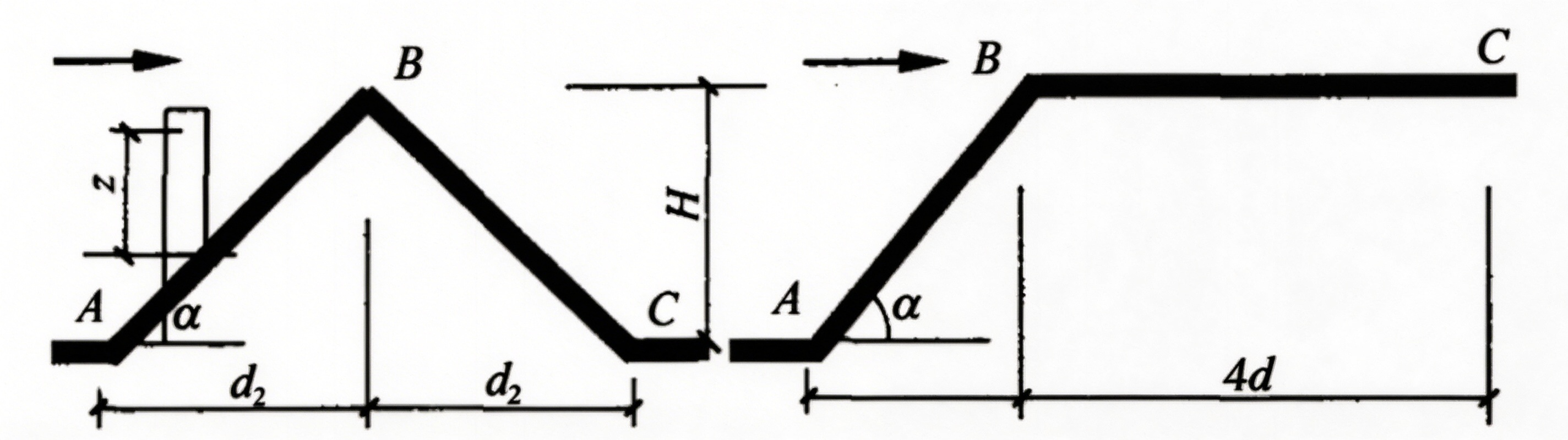
Figure 2 Schematic diagram of hills and slopes
This model explicitly retains information on slope gradient, hill/slope type, planar position and height-dependent attenuation. Its explanatory notes also remind that terrain effects are complex; the formula applies only to relatively simple terrain. For complex cases, site-specific data or dedicated research shall be adopted. [2]
2.3 Approach B: GB 50135 — Reference height to surrounding flat ground
Item 3 of Clause 4.2.6 in GB 50135 states that, for high-rise structures in mountainous regions, the wind-pressure height-variation factor may be calculated using the height from the structural calculation position to the adjacent flat surrounding terrain. Its commentary further clarifies that this surrounding flat ground refers to the nearest terrain of Category-B roughness. [3]
μz,eff = μB(hm + z)
Here hₘ is the height difference between the tower base and the surrounding flat ground; z remains the height of the calculation point measured from the tower base.
No η factor from the GB 50009 hill formula is multiplied in this workflow. The reason is not that the two algorithms are strictly equivalent, but that, as explicitly stated in the GB 50135 commentary, based on extensive engineering experience with high-rise structures, the terrain-correction coefficient originally provided for mountain high-rise structures was found inapplicable and has therefore been deleted in this revision, replaced by the above height-referencing method. [3]
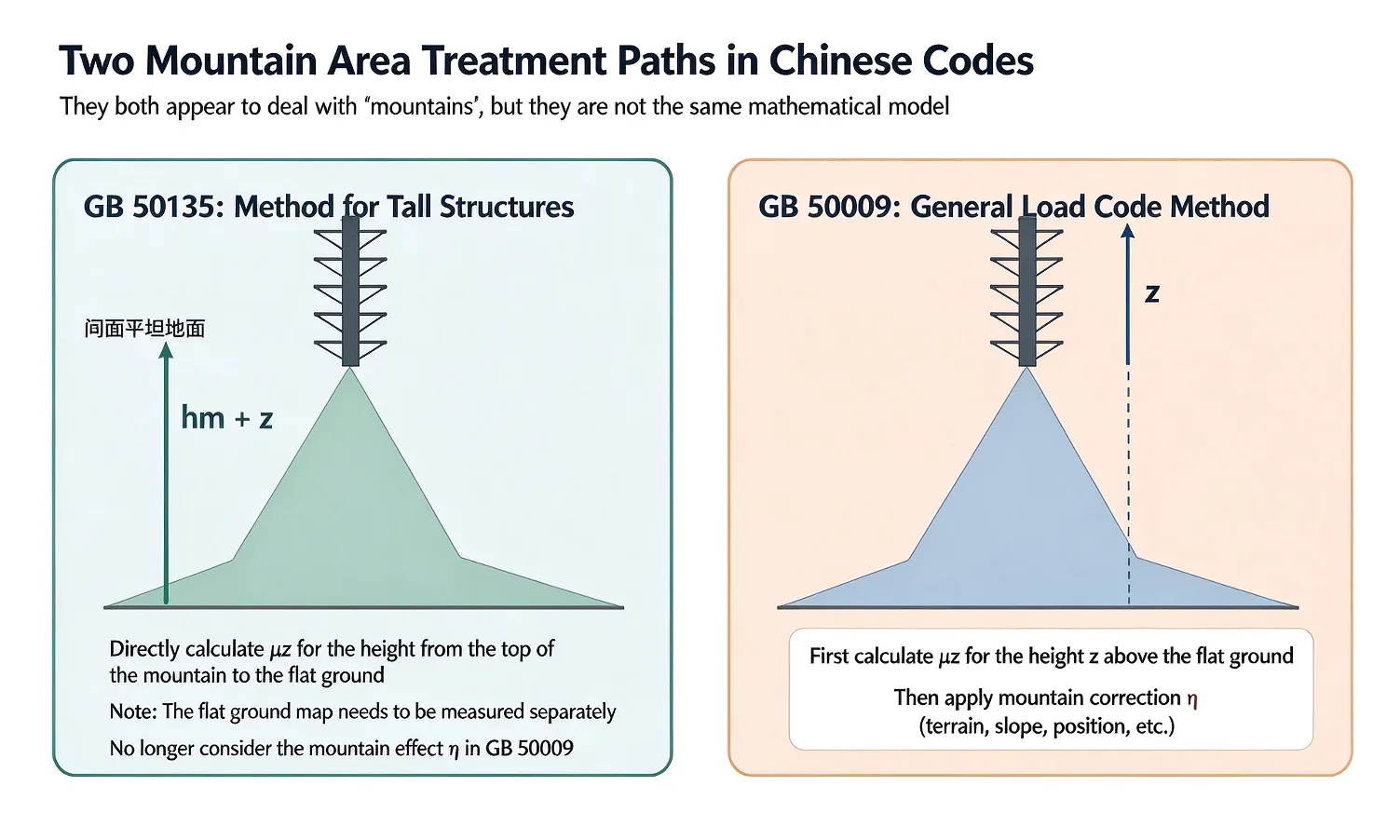
Figure 3 Two mountain-terrain treatment paths in Chinese codes: not equivalent transformations
2.4 Why results sometimes agree and sometimes differ significantly
Using the same teaching example: the mountain summit is 100 m higher than the surrounding Category-B flat ground, the tower is 50 m high and located right on the summit. Only the “height/terrain” part of the mean wind pressure is compared; shape factor and gust-response factor are excluded.
|
Calculation Location |
GB 50135 Method |
GB 50009: tanα = 0.10 |
GB 50009: tanα = 0.30 |
|
Tower base |
μB(100 m) = 2.00 |
μB(min)×η ≈ 1.00×1.49 = 1.49 |
≈ 1.00×2.76 = 2.76 |
|
Tower top |
μB(150 m) = 2.25 |
μB(50 m)×η ≈ 1.62×1.38 = 2.24 |
≈ 1.62×2.33 = 3.78 |
Table 2 Teaching example: comparison of the two Chinese approaches along the tower height
For the gentle-slope example, results at the tower top (2.24 vs. 2.25) are almost identical, but they already differ at the tower base. The steep-slope example differs much more. This proves that the two methods may coincide by chance at a certain height, but do not guarantee point-by-point agreement along the whole tower height, and are by no means an algebraic transformation of the same formula.
Engineering Takeaway: When a communication tower falls within the scope of GB 50135, the dedicated provisions of GB 50135 shall be followed while satisfying the mandatory requirements of GB 55001. Do not superimpose the GB 50135 “surrounding flat-ground height” with the GB 50009 η factor again, nor compute by both approaches and arbitrarily select the smaller value.
2.5 Practical Decision Workflow for Chinese Projects
· First confirm whether the structure qualifies as a high-rise structure under the GB 50135 definition. Communication towers usually do.
· First satisfy the mandatory requirements of GB 55001, then determine the basic wind pressure, μz, shape factor and gust-response factor in accordance with GB 50135; for mountain sites, handle μz under Clause 4.2.6.
· For the 10 m wind pressure in intermountain basins, valleys, valley mouths or passes, give priority to investigation and analysis under Clause 4.2.4 of GB 50135; use the adjustment ranges given in the code commentary only when data are lacking.
· For complex terrain or complex structural geometry, adopt wind-tunnel tests or numerical simulation under Clause 4.2.16 of GB 50135.
III. US Standard: Kz, Kzt and Ke — Separate Roles for Tower Height, Terrain and Elevation
Under ANSI/TIA-222-I, using SI units, the coefficient chain for velocity pressure can be written as:
qz = 0.613·Kz·Kzt·Ks·Ke·Kd·V²
Here qz is in N/m² and V in m/s; the specific values of each coefficient shall be taken from the corresponding clauses and tables of TIA-222-I. [4]
|
Coefficient |
What It Controls |
Height Reference / Reminder |
|
Kz |
Exposure and variation with height |
z measured above ground at the structure base |
|
Kzt |
Terrain acceleration over hills, ridges, escarpments |
H is height relative to surrounding terrain, not elevation |
|
Ks |
Speed-up for roof-mounted structures |
Normally 1 for free-standing ground towers; shall be stated |
|
Ke |
Air-density change due to ground elevation |
zₛ is the elevation; do not confuse it with z |
|
Kd |
Wind directionality |
Must not be omitted from the full velocity-pressure formula |
Table 3 Roles of each coefficient for velocity pressure in the US standard
IV. Eurocode: cr and c₀ Act on the Wind-Speed Layer — Do Not Directly Match μz
This article follows the first-generation EN 1991-1-4:2005+A1:2010. European projects must also apply the National Annex of the country where the project is located; the second-generation Eurocodes are in transition, and engineering design shall follow the version enforced in the country at the time of execution. [5][6]
vm(z) = cr(z)·c0(z)·vb
qp(z) = [1 + 7·Iv(z)]·½·ρ·vm(z)²
Here cr(z) is the roughness factor and c₀(z) is the terrain factor; both first act on the mean wind speed. This differs from the Chinese μz and the American Kz, which act directly on the pressure layer. In cr, z is measured above the site ground level and is subject to the minimum height zmin for each terrain-roughness category. [5]
V. Comparing Chinese, American and European Codes in One Table
|
Comparison Item |
China GB 50009 / GB 50135 |
USA TIA-222-I |
Europe EN 1991-1-4 |
|
Basic wind input |
Basic wind pressure w₀; not less than 0.35 kN/m² for high-rise structures |
Basic wind speed V |
Basic wind speed vb, combined with the National Annex |
|
General height factor |
μz acts on the pressure layer |
Kz acts on the pressure layer |
cr acts on the mean-wind-speed layer |
|
Mountain treatment |
GB 50009: μz×η; GB 50135: μz may be referenced to surrounding flat-ground height |
Kzt, per the method of Section 2.6.6 |
c₀ acts on the mean wind speed |
|
Elevation effect |
Enters through local air density when determining w₀; no repeated correction |
Ke; elevation and units must match |
ρ and provisions of the National Annex |
|
Complex terrain |
Dedicated study, wind-tunnel test or numerical simulation |
Wind-tunnel/CFD procedures per Section 2.10 |
National Annex provisions or a more suitable dedicated study |
Table 4 Comparison of mountain-site wind-load provisions across Chinese, American and European codes
The most important takeaway from this table is not memorizing the symbols, but seeing clearly “which layer each coefficient acts on”. Although μz, Kz and cr are all related to height, their numerical values cannot be directly compared; Kzt and c₀ also act on the pressure layer and the wind-speed layer respectively.
VI. Five Test Questions to Verify Whether You Really Understand
Q1: Tower height is 50 m and mountain height is 100 m — can z = 150 m be used directly?
It cannot be answered without reference to a code. Under the GB 50135 method for mountain high-rise structures, the tower-top calculation position may be referenced to the surrounding flat ground at 150 m for μz; under the GB 50009 method, z remains 50 m above the tower base, and the terrain correction η is then multiplied.
Q2: Do these two Chinese methods give identical results?
No. They may be close at a certain height on gentle slopes, but the distribution along the tower height differs, and the divergence can be large on steep slopes.
Q3: Can an elevation of 2000 m be added into the height coefficient?
No. Elevation mainly enters the air density, Ke or the site basic wind parameters; it does not enter the height-above-ground z.
Q4: For mountain ranges that do not satisfy the “isolated hill” condition, is Kzt simply taken as 1?
This conclusion cannot be drawn. The simplified standard model not being applicable does not mean the real airflow has no acceleration; complex mountainous sites should adopt a site study, wind-tunnel test or reliable CFD.
Q5: With thinner air at high altitude, is the wind load necessarily smaller?
Only under the assumption that the design wind speed and all other conditions are identical does the lower air density reduce the velocity pressure. In real projects, extreme wind speed, mountain-gap effects, roughness and dynamic response may control in the opposite direction.
Referenced Standards and Clause Locations
[1] GB 55001-2021, General Code for Engineering Structures: Clause 4.6.1 (wind-load composition and terrain-correction requirements).
[2] GB 50009-2012, Load Code for the Design of Building Structures: Section 8.1, Clauses 8.2.1, 8.2.2 and Appendix E.2.4 (basic wind pressure, mountain-terrain correction, air density).
[3] GB 50135-2019, Standard for Design of High-rise Structures: Clauses 4.2.1–4.2.6, 4.2.16 and the corresponding explanatory notes.
[4] ANSI/TIA-222-I (2023), Structural Standard for Antenna Supporting Structures, Antennas and Small Wind Turbine Support Structures: Sections 2.6.5–2.6.8, 2.6.11.6, 2.10.
[5] EN 1991-1-4:2005+A1:2010, Eurocode 1 — Actions on structures — Part 1-4: Wind actions: Clauses 4.2, 4.3.2, 4.3.3, 4.4, Annex A.3, together with the National Annex of the country where the project is located.
[6] European Commission JRC: Second Generation of the Eurocodes (implementation and withdrawal timetable of the new-generation Eurocodes).