Three-Leg Lattice Tower vs Four-Leg Lattice Tower: Advantages, Disadvantages and Application Scenarios
Compare three-leg and four-leg lattice towers: advantages, disadvantages and application scenarios for transmission and industrial steel structures.
Three-Leg Angle Steel Tower vs Four-Leg Angle Steel Tower: Advantages, Disadvantages and Application Scenarios
Opening Conclusion
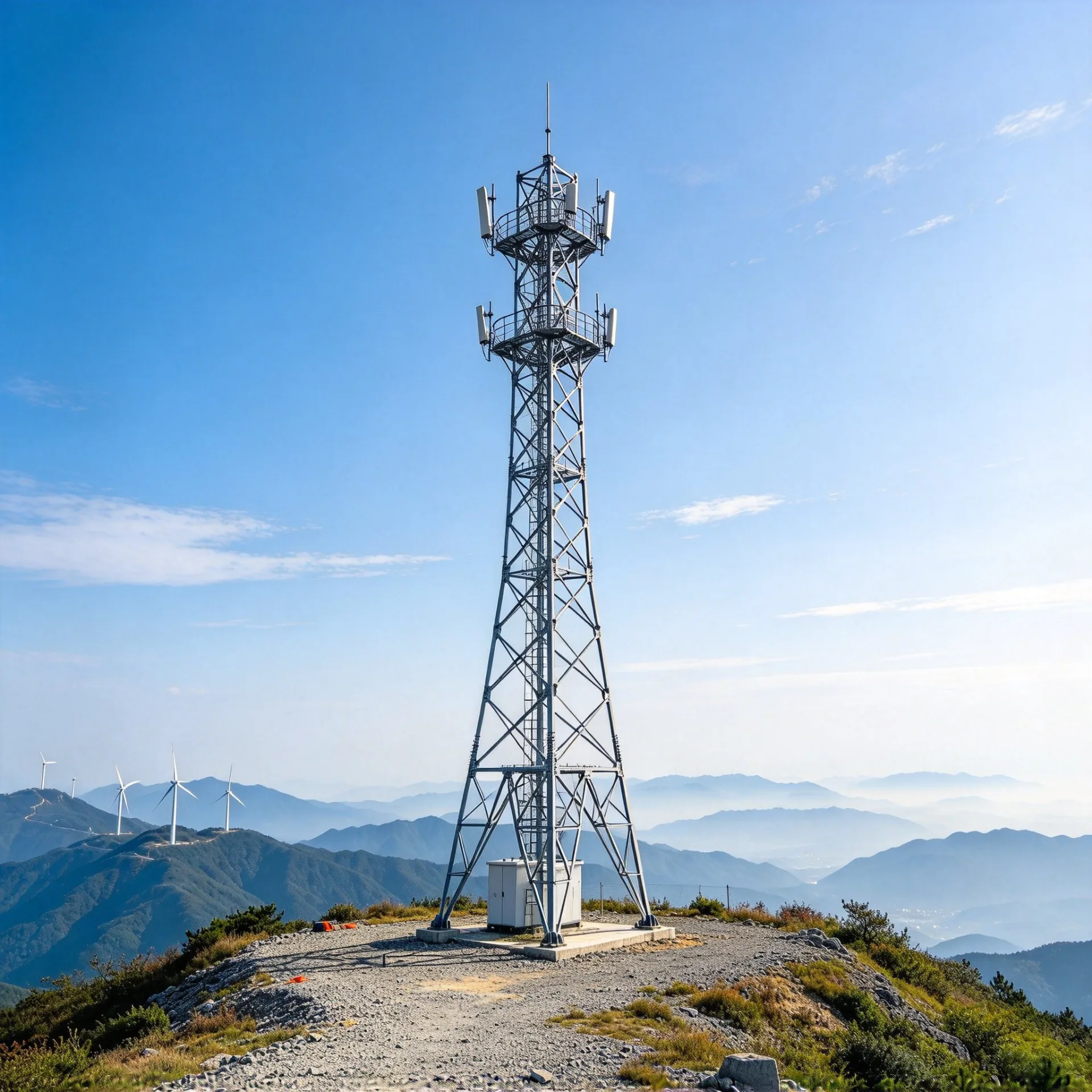
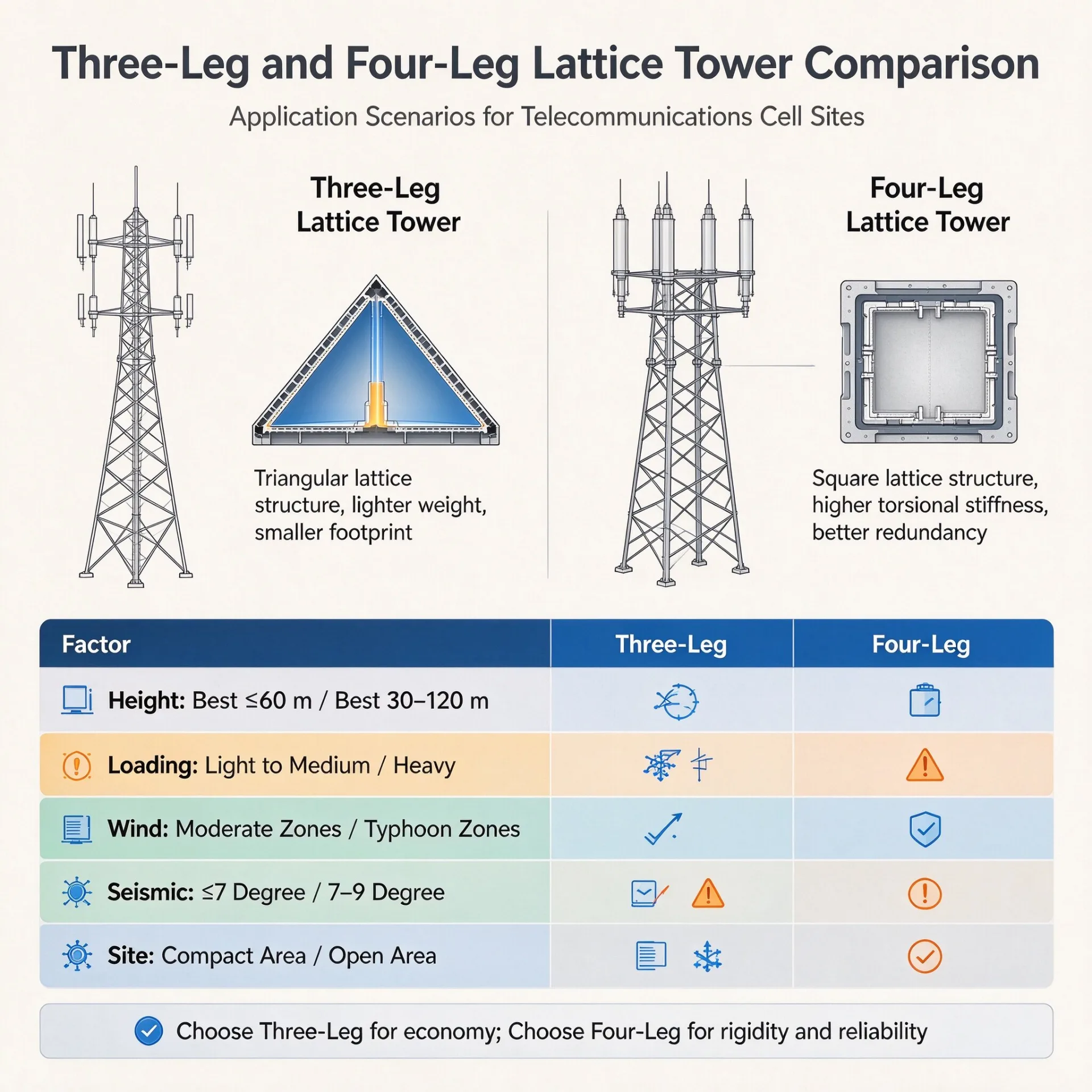
The three-leg angle steel tower is a statically determinate space truss with a triangular cross-section. Its core advantages are lower steel consumption, fewer foundations, a smaller footprint and faster construction; its weaknesses are poor torsional stiffness, low structural redundancy and large reaction at each individual foundation, and it is limited by height and loading conditions. It is therefore suitable for ordinary wide-coverage base stations with a height of ≤ 60 m, light equipment loading, a small site and good ground conditions.
The four-leg angle steel tower is a statically indeterminate space truss with a square cross-section. Its core advantages are high torsional stiffness, high safety redundancy, strong load-carrying capacity and flexible equipment arrangement; its weaknesses are greater steel consumption, more foundations, a larger footprint and heavier construction workload. It is therefore suitable for tall towers, co-located multi-microwave sites, typhoon / high-seismic-intensity regions, general ground conditions and important hub base stations. Both types can achieve a high design wind speed by adjusting their members, but the inherent structural differences in torsional performance and redundancy cannot be eliminated simply by raising the steel strength.
Scenario Selection Summary Table
|
Selection Condition |
Prefer Three-Leg Angle Steel Tower |
Prefer Four-Leg Angle Steel Tower |
|
Tower height |
15-60 m; not recommended above 60 m |
30-120 m; tall towers above 60 m are preferred |
|
Equipment loading |
Ordinary sector antennas, microwave ≤ 2 sets, light-to-medium load |
Co-located multi-operator, multiple microwave antennas, heavy load, large future expansion |
|
Site and footprint |
Mountain, hilltop, land-acquisition-constrained, small site |
Open site that can accommodate 4 independent foundations |
|
Ground conditions |
High bearing capacity, natural footing sufficient; not for weak soil |
General or weak soil acceptable; foundation reactions dispersed, lower pile probability |
|
Wind conditions |
Moderate wind zone, not typhoon core; strict torsional check required |
Coastal typhoon zone, strong gust zone, heavy-load high-wind sites preferred |
|
Seismic conditions |
Moderate intensity (≤ VII); not recommended for important sites of VIII and above |
VII-IX high seismic intensity; preferred for seismic-sensitive and important communication sites |
|
Site importance |
Ordinary wide-coverage suburban / rural base station |
Backbone microwave station, hub base station, emergency important communication tower |
|
Cost orientation |
Control cost, reduce steel and concrete |
Prioritize structural safety and equipment reliability over cost |
I. Three-Leg Angle Steel Tower (Triangular Self-Supporting Angle Steel Tower)
Advantages
· Good material economy: for the same height and design wind speed, it saves about 15%-25% of steel compared with the four-leg tower; fewer members and bolts reduce fabrication, hot-dip galvanizing and transport costs.
· Less foundation work and smaller footprint: only 3 independent foundations, fewer pits and less concrete; the overall foundation footprint is small, ideal for hilltop and narrow mountain-platform sites.
· High on-site erection efficiency: fewer members and simplified component types reduce assembly work and shorten construction period, suitable for remote mountainous and overseas sites.
· Slightly smaller windward area: the triangular section has a somewhat better shape factor, giving slightly lower tower-self wind load than the four-leg tower.
· Lower self-weight for seismic action: the lighter tower weight gives a smaller total seismic horizontal force, an advantage at moderate intensity.
Disadvantages
· Weak torsional stiffness (the main shortcoming): as a statically determinate space truss, torque is mainly carried by the diagonal bracing members; oblique wind or multi-directional antenna loading can produce a large tower-top twist. Microwave antennas are very sensitive to rotation, and excessive twist causes communication errors. The tower-top torsion angle must be mandatorily verified in design. Enlarging the main members only improves torsion stiffness to a limited extent.
· Low structural safety redundancy: a statically determinate structure with three main legs; if one main leg or a key diagonal member is damaged, there is no alternative load path and the tower may collapse progressively as a whole; under strong wind or earthquake, local failure easily triggers global instability.
· Large reaction at each individual foundation: all loads concentrate on 3 foundations, so the vertical and overturning reaction per foundation is large. On weak ground, piles become necessary, offsetting the cost advantage of the three-leg tower; under seismic action a single foundation also takes a large seismic overturning force.
· Limited height and loading: stiffness degrades noticeably above 60 m; not suitable for many microwave antennas or heavy equipment.
· Limited equipment arrangement: with three faces, arranging antennas, platforms and ladders on four sides may cause member interference.
Applicable Scenarios (including wind and seismic)
· Ordinary communication base stations on mountain, hilltop, high land-acquisition-cost, small platforms.
· Tower height 15-60 m, moderate wind zone without strong typhoon; seismic intensity ≤ VII.
· Mainly ordinary sector antennas, microwave links ≤ 2 sets, medium or lower equipment load.
· Good ground conditions with high bearing capacity, allowing natural independent footings.
· Suburban and rural wide-coverage ordinary base stations where the project is cost-sensitive.
· Remote overseas sites prioritizing transport and assembly convenience.
Not-applicable Scenarios
· Tower height above 60 m.
· Co-located multi-operator sites with multiple microwave antennas arranged on four sides.
· Coastal typhoon zone, very large gust zone; important sites with seismic intensity VIII and above.
· Weak soil such as silt or soft clay.
· Backbone hub microwave towers, emergency security and other high-reliability communication towers.
II. Four-Leg Angle Steel Tower (Square Self-Supporting Angle Steel Tower)
Advantages
· Excellent torsional stiffness: as a square statically indeterminate truss, its torsional stiffness is about 40% higher than that of the three-leg tower under the same conditions. Under oblique wind or multi-directional loading the tower-top twist is small, keeping microwave antennas stable and giving strong resistance to oblique-wind torsion.
· High structural safety redundancy: the statically indeterminate system redistributes internal forces when local members are damaged, so it does not collapse suddenly as a whole; the safety margin is higher under typhoon and strong earthquakes.
· Strong load-carrying capacity and wide applicable height range: can reach 80-120 m tall towers with strong heavy-load capacity.
· Foundation reactions are dispersed: 4 foundations share vertical, wind-overturning and seismic-overturning loads, giving a lower reaction per foundation and better adaptability to ground conditions; it has an advantage over the three-leg tower on weak soil.
· Flexible equipment arrangement: four faces give less interference for antennas, microwaves, platforms and ladders, facilitating co-located multi-operator expansion.
· Good seismic performance: the multi-leg statically indeterminate system redistributes internal forces under earthquakes, giving better global stability than the three-leg tower at high intensity.
Disadvantages
· Greater steel consumption: about 15%-25% more steel than the three-leg tower under the same conditions, raising tower material cost.
· More foundation work and larger footprint: requires 4 independent foundations, more pits and concrete; needs a larger site area and sometimes cannot be arranged on a narrow hilltop.
· More members and bolts, so fabrication, galvanizing, transport and on-site assembly workload are larger, with a longer construction period and higher labor cost.
Applicable Scenarios (including wind and seismic)
· Tall towers above 60 m, communication hub towers and broadcast towers.
· Co-located multi-operator sites with multiple microwave antennas and multi-directional equipment.
· Coastal typhoon zones and strong-gust regions; regions of VII-IX high seismic intensity.
· General or poor ground conditions with low natural bearing capacity.
· Backbone microwave stations, emergency communication towers and other important high-reliability sites.
· Overseas TIA-222 (US standard) projects with many microwave links.
Not-applicable Scenarios
· Extremely small site platforms that cannot accommodate 4 foundations.
· Low, ordinary wide-coverage stations with good site conditions and a strictly limited budget (a three-leg tower may be preferred).
Supplementary Engineering Notes
· A three-leg tower is not incapable of a high design wind speed: enlarging the root spread and the main angle sections improves the along-wind bending capacity, but the inherent torsional shortcoming cannot be eliminated, and the cost advantage of the three-leg tower is meanwhile lost.
· A three-leg tower design must include a tower-top torsion check; even if no microwave antenna is mounted, the torsional deformation limit shall be controlled. High seismic intensity is not recommended for three-leg towers used on important sites.
· Tower-type selection must not compare tower steel weight alone; the foundation cost must also be assessed. Where a three-leg tower requires piles on weak soil, the overall cost may be higher than that of a four-leg tower.
· Under seismic action the low self-weight of the three-leg tower is an advantage, but as a statically determinate structure it lacks the ability to redistribute internal forces, and at high intensity this disadvantage governs for important sites.